Crossing the Blues
Showing posts with label Concept Car. Show all posts

Tuesday, December 8, 2009

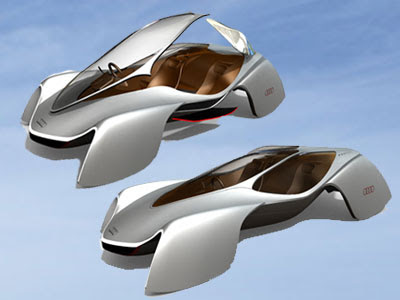
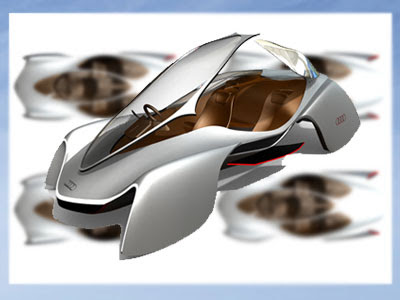
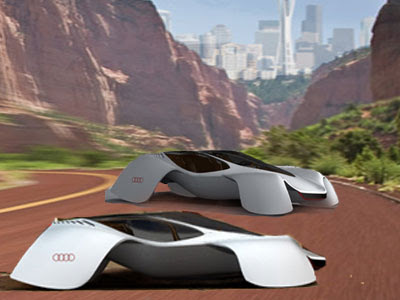
2009 Audi Avatar concept Car is an electric powered supercar concept

2009 Audi Avatar concept Car

The Audi Avatar is a concept vehicle which was created by Edwin Conan (Yi Yuan), a graduate of RMIT (Royal Melbourne Institute of Technology) University in Australia. The Avatar was developed during Edwin's final year at the university as part of his degree project.
The Avatar is an electric powered supercar concept which is designed for about 20-25 years in the future. The shape was inspired by the 1937 Auto Union Type C Streamline racing car, and both cars - even though they are separated by a century - share the same clinical lines and pronounced wheel arches.
2009 Audi Avatar concept Car

There are no conventional doors to the Avatar, instead the vehicle utilizes a three-part canopy which opens upward to provide entry and exit. The main canopy opens forward together with the steering wheel and the dashboard, while two smaller canopies above the passenger seats open backwards. At the same time a panel in the bodywork drops down to act as a step.
2009 Audi Avatar concept Car

The interior of the Audi Avatar features a three-seat layout with the driver sitting in a central position forward of the passenger seats. The driver is met with a futuristic dashboard which consists of a transparent LCD display which provides all essential driving data. In the center of the steering wheel is another screen which provides navigation information. Additional information can also be projected onto the canopy to provide a heads-up-display similar to those found in high performance aircraft.
Thanks to a drive-by-wire system the Avatar's steering wheel can be swapped out quickly and easily in favor of a joystick or even a keypad depending on driver preferences.
2009 Audi Avatar concept Car

Powering the Audi Avatar is an all-electric drivetrain which comprises of four individual electric motors (one for each wheel), and a pair of high-performance battery packs. The battery packs are split in two to provide better weight distribution, one is located at the front and one at the rear. In total the projected output is 544 horsepower, and 4,500 Nm (3,319 lb-ft) of torque. This gives the car a theoretical top speed of 223 mph (360 Km/h), and a 0-62 mph (100 km/h) time of 2.9 seconds.
2009 Audi Avatar concept Car

The wheels of the Avatar are housed inside the car's four 'legs'. The legs are constructed from a deformable material which allows it to change shape when the wheel is turned. To increase the vehicle's agility and handling, the Avatar features a four-wheel-steering system. The front wheels provide most of the steering, while the rear wheels can turn up to 10 degrees.

2009 Audi Avatar concept Car is an electric powered supercar concept

2009 Audi Avatar concept Car

The Audi Avatar is a concept vehicle which was created by Edwin Conan (Yi Yuan), a graduate of RMIT (Royal Melbourne Institute of Technology) University in Australia. The Avatar was developed during Edwin's final year at the university as part of his degree project.
The Avatar is an electric powered supercar concept which is designed for about 20-25 years in the future. The shape was inspired by the 1937 Auto Union Type C Streamline racing car, and both cars - even though they are separated by a century - share the same clinical lines and pronounced wheel arches.
2009 Audi Avatar concept Car

There are no conventional doors to the Avatar, instead the vehicle utilizes a three-part canopy which opens upward to provide entry and exit. The main canopy opens forward together with the steering wheel and the dashboard, while two smaller canopies above the passenger seats open backwards. At the same time a panel in the bodywork drops down to act as a step.
2009 Audi Avatar concept Car

The interior of the Audi Avatar features a three-seat layout with the driver sitting in a central position forward of the passenger seats. The driver is met with a futuristic dashboard which consists of a transparent LCD display which provides all essential driving data. In the center of the steering wheel is another screen which provides navigation information. Additional information can also be projected onto the canopy to provide a heads-up-display similar to those found in high performance aircraft.
Thanks to a drive-by-wire system the Avatar's steering wheel can be swapped out quickly and easily in favor of a joystick or even a keypad depending on driver preferences.
2009 Audi Avatar concept Car

Powering the Audi Avatar is an all-electric drivetrain which comprises of four individual electric motors (one for each wheel), and a pair of high-performance battery packs. The battery packs are split in two to provide better weight distribution, one is located at the front and one at the rear. In total the projected output is 544 horsepower, and 4,500 Nm (3,319 lb-ft) of torque. This gives the car a theoretical top speed of 223 mph (360 Km/h), and a 0-62 mph (100 km/h) time of 2.9 seconds.
2009 Audi Avatar concept Car

The wheels of the Avatar are housed inside the car's four 'legs'. The legs are constructed from a deformable material which allows it to change shape when the wheel is turned. To increase the vehicle's agility and handling, the Avatar features a four-wheel-steering system. The front wheels provide most of the steering, while the rear wheels can turn up to 10 degrees.

Sunday, December 6, 2009

2009 concept Chevrolet Camaro Dusk a very tailored look with a distinct American accent

Chevrolet Camaro Dusk 2009 concept

Urban professionals,Inspired by the style of young, the Camaro Dusk concept rolls with a contemporary tuner aesthetic. It is understatedly aggressive looking, with a lowered ride height, new 21-inch wheels, the rear spoiler from an SS model and a custom ground effects package.
“This is a car with an international flair, bringing the Camaro to a place it hasn’t traditionally been,” said Parker. “It is a very tailored look that is stylish and sophisticated, but with a distinct American accent.”
Chevrolet Camaro Dusk 2009 concept

The ground effects package includes a racing-inspired front splitter, rocker extensions and a rear diffuser. They are prototype parts that may enter production as dealer-available accessories at a later date; the same goes for the 21-inch wheels from BBS. Many of the details, such as the taillamp and fog lamp bezels, match the finish of the wheels, lending a more premium look to the car.
The Camaro Dusk’s body is painted Berlin Blue, while the ground effects are painted a contrasting color. Additional performance items include the exhaust system and Brembo brakes from a Camaro SS (with painted calipers). The interior is trimmed in stylish Jet Black and Sedona, with complementing features including footwell lighting, premium door sill plates and other details.
Chevrolet Camaro Dusk 2009 concept

Today’s young professionals expect advanced technology and premium audio options and this concept delivers with a crisp, well-tuned Boston Acoustics sound system, WiFi connectivity and a convenient cradle for an iPhone.
Camaro designers dreamed up half a dozen proposals for accessory graphics packages, with the intent of soliciting feedback from Camaro enthusiasts for possible production. Chevrolet then launched the graphics campaign in mid-October, asking Camaro fans on Facebook to pick their favorite design.
The top four designs were produced and brought to the SEMA Convention, where a Silver Ice Metallic Camaro will wear each contender on a different day. At the conclusion of the convention, after thousands of enthusiasts see the graphics on the car in person and on Facebook, another round of voting will occur. The top vote-getter will be considered for future production.
Chevrolet Camaro Dusk 2009 concept

“Camaro has thousands of fans on the various social media sites and this is a great way to demonstrate that Chevrolet is connected to our customers,” said Dewar. “With so many great designs to choose from, we’re sure the voting will be close, but whatever the outcome, the real winners will be the customers who personalize their Camaro with the winning graphics package.”
The Camaro Graphics display vehicle will be located prominently in the GM display during the SEMA Convention, starting on Tuesday, Nov. 3, 2009. At the close of the convention each day, the graphics package will be changed.

2009 concept Chevrolet Camaro Dusk a very tailored look with a distinct American accent

Chevrolet Camaro Dusk 2009 concept

Urban professionals,Inspired by the style of young, the Camaro Dusk concept rolls with a contemporary tuner aesthetic. It is understatedly aggressive looking, with a lowered ride height, new 21-inch wheels, the rear spoiler from an SS model and a custom ground effects package.
“This is a car with an international flair, bringing the Camaro to a place it hasn’t traditionally been,” said Parker. “It is a very tailored look that is stylish and sophisticated, but with a distinct American accent.”
Chevrolet Camaro Dusk 2009 concept

The ground effects package includes a racing-inspired front splitter, rocker extensions and a rear diffuser. They are prototype parts that may enter production as dealer-available accessories at a later date; the same goes for the 21-inch wheels from BBS. Many of the details, such as the taillamp and fog lamp bezels, match the finish of the wheels, lending a more premium look to the car.
The Camaro Dusk’s body is painted Berlin Blue, while the ground effects are painted a contrasting color. Additional performance items include the exhaust system and Brembo brakes from a Camaro SS (with painted calipers). The interior is trimmed in stylish Jet Black and Sedona, with complementing features including footwell lighting, premium door sill plates and other details.
Chevrolet Camaro Dusk 2009 concept

Today’s young professionals expect advanced technology and premium audio options and this concept delivers with a crisp, well-tuned Boston Acoustics sound system, WiFi connectivity and a convenient cradle for an iPhone.
Camaro designers dreamed up half a dozen proposals for accessory graphics packages, with the intent of soliciting feedback from Camaro enthusiasts for possible production. Chevrolet then launched the graphics campaign in mid-October, asking Camaro fans on Facebook to pick their favorite design.
The top four designs were produced and brought to the SEMA Convention, where a Silver Ice Metallic Camaro will wear each contender on a different day. At the conclusion of the convention, after thousands of enthusiasts see the graphics on the car in person and on Facebook, another round of voting will occur. The top vote-getter will be considered for future production.
Chevrolet Camaro Dusk 2009 concept

“Camaro has thousands of fans on the various social media sites and this is a great way to demonstrate that Chevrolet is connected to our customers,” said Dewar. “With so many great designs to choose from, we’re sure the voting will be close, but whatever the outcome, the real winners will be the customers who personalize their Camaro with the winning graphics package.”
The Camaro Graphics display vehicle will be located prominently in the GM display during the SEMA Convention, starting on Tuesday, Nov. 3, 2009. At the close of the convention each day, the graphics package will be changed.

Friday, December 4, 2009

2009 Audi e-Tron Concept Car A High-Performance Sports Car

2009 Audi e-Tron Concept Car

The Audi e-tron Concept 2009, a high-performance sports car with a purely electric drive system. Four motors - two each at the front and rear axles - drive the wheels, making the concept car a true quattro. Producing 230 kW (313 hp) and 4,500 Nm (3,319.03 lb-ft) of torque, the two-seater accelerates from 0 to 100 km/h (0 - 62.14 mph) in 4.8 seconds, and from 60 to 120 km/h (37.28 - 74.56 mph) in 4.1 seconds. The lithium-ion battery provides a truly useable energy content of 42.4 kilowatt hours to enable a range of approximately 248 kilometers.

2009 Audi e-Tron Concept Car

The performance figures are by no means the only evidence of the consistent and holistic strategy. The design makes it clear that the Audi e-tron Concept belongs in the major leagues of sports cars, and the package takes into account the specific realities of an electric vehicle. The battery is directly behind the passenger cabin for an optimal center of gravity and axle load distribution.

2009 Audi e-Tron Concept Car

The Audi e-tron Concept is able to freely distribute the powerful torque of its four electric motors to the wheels as required. This so-called torque vectoring allows for dazzling dynamics and an undreamed-of level of agility and precision when cornering.
The electric driving potentially offers numerous advantages. Electric cars reduce the dependence of transportation and the economy on the raw material petroleum. They produce no direct exhaust emissions and thus ease the local burden on the environment.
2009 Audi e-Tron Concept Car

Electric drive systems are also significantly more efficient than combustion engines, consequently making them easier on the customers' wallets. Other strengths include sportiness and the fun they bring to driving. All of Audi has taken a new and in some cases revolutionary approach to many of the technical modules. A heat pump is used to efficiently warm up and heat the interior.
2009 Audi e-Tron Concept Car

The drive system, the power electronics and the battery are controlled by an innovative thermal management system that is a crucial component for achieving the car's range without compromising its high level of interior comfort. Networking the vehicle electronics with the surroundings, which is referred to as car-to-x communication, opens new dimensions for the optimization of efficiency, safety and convenience.

2009 Audi e-Tron Concept Car A High-Performance Sports Car

2009 Audi e-Tron Concept Car

The Audi e-tron Concept 2009, a high-performance sports car with a purely electric drive system. Four motors - two each at the front and rear axles - drive the wheels, making the concept car a true quattro. Producing 230 kW (313 hp) and 4,500 Nm (3,319.03 lb-ft) of torque, the two-seater accelerates from 0 to 100 km/h (0 - 62.14 mph) in 4.8 seconds, and from 60 to 120 km/h (37.28 - 74.56 mph) in 4.1 seconds. The lithium-ion battery provides a truly useable energy content of 42.4 kilowatt hours to enable a range of approximately 248 kilometers.

2009 Audi e-Tron Concept Car

The performance figures are by no means the only evidence of the consistent and holistic strategy. The design makes it clear that the Audi e-tron Concept belongs in the major leagues of sports cars, and the package takes into account the specific realities of an electric vehicle. The battery is directly behind the passenger cabin for an optimal center of gravity and axle load distribution.

2009 Audi e-Tron Concept Car

The Audi e-tron Concept is able to freely distribute the powerful torque of its four electric motors to the wheels as required. This so-called torque vectoring allows for dazzling dynamics and an undreamed-of level of agility and precision when cornering.
The electric driving potentially offers numerous advantages. Electric cars reduce the dependence of transportation and the economy on the raw material petroleum. They produce no direct exhaust emissions and thus ease the local burden on the environment.
2009 Audi e-Tron Concept Car

Electric drive systems are also significantly more efficient than combustion engines, consequently making them easier on the customers' wallets. Other strengths include sportiness and the fun they bring to driving. All of Audi has taken a new and in some cases revolutionary approach to many of the technical modules. A heat pump is used to efficiently warm up and heat the interior.
2009 Audi e-Tron Concept Car

The drive system, the power electronics and the battery are controlled by an innovative thermal management system that is a crucial component for achieving the car's range without compromising its high level of interior comfort. Networking the vehicle electronics with the surroundings, which is referred to as car-to-x communication, opens new dimensions for the optimization of efficiency, safety and convenience.

Wednesday, November 25, 2009

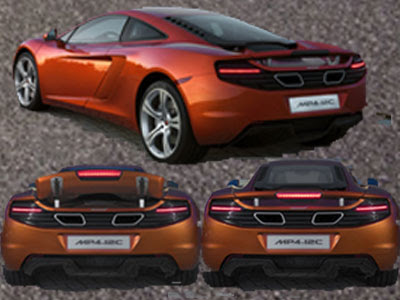
2011 McLaren MP4-12C Super Sports Concept Car pure McLaren, Powered by a twin-turbocharged 3.8 litre, V8 Engine


2011 McLaren MP4-12C

The independent car division based at the McLaren Technology Centre in Woking, England,the McLaren MP4-12C is revealed as the first in a range of high-performance sports cars from McLaren Automotive.The 12C, and future models within the range, will challenge the world's best sports cars, benefiting from the expertise and virtuosity of the McLaren Group.
Through a rich modern history, McLaren's automotive division has already built the world's most critically acclaimed supercar, the McLaren F1 (1993-1998) and the world's best-selling luxury supercar, the Mercedes-Benz SLR McLaren (2003-2009). McLaren Automotive now looks to the future with a new range of revolutionary sports cars.
At its heart, the McLaren MP4-12C features a revolutionary carbon fibre chassis structure, the Carbon MonoCell: the first time a car in this market segment is based around such a strong and lightweight racing car engineering solution and the first time any car has ever featured a one-piece carbon fibre structure.
2011 McLaren MP4-12C

Martin Whitmarsh : "McLaren has for years offered a potent mix of race car and road car technologies. This combination of McLaren's performance heritage, and future demands on what is expected of high performance sports cars in the 21st century, gave us a head-start when we embarked on this project. The 12C, and future variants, draws on the spirit of Formula 1 and delivers real-world technological advances."
The first car from the new company, the McLaren MP4-12C, is a high performance two-seat mid-engine model in the 'core' sports car market segment for cars costing between £125,000 and £175,000.It goes on sale through a dedicated, worldwide retailer network in early 2011.
All the parts of the McLaren MP4-12C are bespoke and unique to this car. Everything from the engine right down to the tailor-made switches and buttons is pure McLaren: nothing has come from another manufacturer's parts bin.
The 12C is powered by a bespoke McLaren 'M838T' 3.8 litre, V8 twin-turbo engine producing around 600bhp, driving through a McLaren seven speed Seamless Shift dual clutch gearbox (SSG). It is targeting not only new standards for power and performance in its sector, but also class-leading fuel economy and CO2 emissions; supported by McLaren's experience of active aerodynamics to aid cooling, grip, handling and road holding.
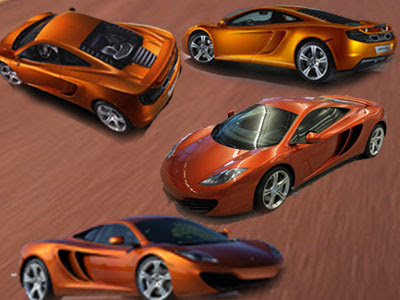
2011 McLaren MP4-12C

"The 12C is all about performance," said Sheriff. "And in McLaren, we have a very broad definition of performance. We don't just look at the traditional one-dimensional parameters like top speed, we focus equally on useable measures such as in-gear acceleration times, braking performance in all conditions, and efficiency of power delivery combined with the lowest possible fuel consumption and CO2 emissions. Sure, 12C is very fast, but it is also the most efficient, most driveable high-performance sports car in the world.
Thorough engineering and market research led to concept development and a clear decision in favour of a mid-engined two door high performance sports car. Intensive work was carried out in the wind tunnel and the driving simulator to ensure that the new car would inherently have superb dynamic qualities.
The McLaren MP4-12C design follows similar principles to McLaren's Formula 1 cars, and the legendary McLaren F1, where everything is for a reason and all lines, surfaces, and details are designed with a job in mind as much as styled. This ensures that the 12C communicates its engineering through its styling and will remain timeless as a piece of automotive design.
"By the time the 12C is launched in 2011 we expect the economic conditions to be much improved. We have already seen significant interest in the car and the supply of the 12C will be relatively scarce; in its first year we plan to produce just 1,000 cars which represents only 3.5 per cent of the 'core' market," explained Antony Sheriff.
2011 McLaren MP4-12C

The McLaren MP4-12C is powered by a twin-turbocharged, 3.8 litre 90 V8 engine - the 'M838T'. This marks the start of a new era in 'core' segment sports cars - smaller capacity, lighter weight, higher efficiency and more economical power units. The engine has the highest specific power output in its segment which, when allied to its low weight carbon composite chassis, delivers exemplary power- and torque-to-weight ratios.The McLaren engine revs to 8,500rpm, has quick transient throttle response and delivers its abundant torque throughout the rev range. A staggering 80 per cent of torque is available at below 2,000rpm, ensuring great driveability and no need to floor the throttle to deliver performance.
The McLaren MP4-12C has been designed around a demanding mechanical package that puts emphasis on aerodynamics, compact dimensions, performance and efficiency, practicality and comfort. Although the design of the 12C was driven by aerodynamics, it aims to remain contemporary and elegant throughout its lifetime as well as distinctive among its peers.
"The 12C design was therefore led by aerodynamics. At McLaren we have been able to use the Formula 1 techniques and the huge expertise that the company has amassed at the pinnacle of the sport," explained Stephenson.
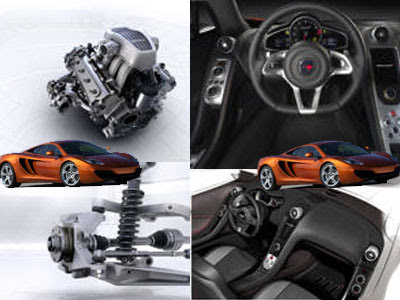
2011 McLaren MP4-12C

Aerodynamic efficiency drove the 12C's design. High downforce helps maintain traction, cornering ability and stability while low drag aids top speed and acceleration. It has a completely flat underbody and smooth upper body surfaces to yield a highly effective drag coefficient and generate very high levels of balanced downforce at high speed.

2011 McLaren MP4-12C Super Sports Concept Car pure McLaren, Powered by a twin-turbocharged 3.8 litre, V8 Engine


2011 McLaren MP4-12C

The independent car division based at the McLaren Technology Centre in Woking, England,the McLaren MP4-12C is revealed as the first in a range of high-performance sports cars from McLaren Automotive.The 12C, and future models within the range, will challenge the world's best sports cars, benefiting from the expertise and virtuosity of the McLaren Group.
Through a rich modern history, McLaren's automotive division has already built the world's most critically acclaimed supercar, the McLaren F1 (1993-1998) and the world's best-selling luxury supercar, the Mercedes-Benz SLR McLaren (2003-2009). McLaren Automotive now looks to the future with a new range of revolutionary sports cars.
At its heart, the McLaren MP4-12C features a revolutionary carbon fibre chassis structure, the Carbon MonoCell: the first time a car in this market segment is based around such a strong and lightweight racing car engineering solution and the first time any car has ever featured a one-piece carbon fibre structure.
2011 McLaren MP4-12C

Martin Whitmarsh : "McLaren has for years offered a potent mix of race car and road car technologies. This combination of McLaren's performance heritage, and future demands on what is expected of high performance sports cars in the 21st century, gave us a head-start when we embarked on this project. The 12C, and future variants, draws on the spirit of Formula 1 and delivers real-world technological advances."
The first car from the new company, the McLaren MP4-12C, is a high performance two-seat mid-engine model in the 'core' sports car market segment for cars costing between £125,000 and £175,000.It goes on sale through a dedicated, worldwide retailer network in early 2011.
All the parts of the McLaren MP4-12C are bespoke and unique to this car. Everything from the engine right down to the tailor-made switches and buttons is pure McLaren: nothing has come from another manufacturer's parts bin.
The 12C is powered by a bespoke McLaren 'M838T' 3.8 litre, V8 twin-turbo engine producing around 600bhp, driving through a McLaren seven speed Seamless Shift dual clutch gearbox (SSG). It is targeting not only new standards for power and performance in its sector, but also class-leading fuel economy and CO2 emissions; supported by McLaren's experience of active aerodynamics to aid cooling, grip, handling and road holding.

2011 McLaren MP4-12C

"The 12C is all about performance," said Sheriff. "And in McLaren, we have a very broad definition of performance. We don't just look at the traditional one-dimensional parameters like top speed, we focus equally on useable measures such as in-gear acceleration times, braking performance in all conditions, and efficiency of power delivery combined with the lowest possible fuel consumption and CO2 emissions. Sure, 12C is very fast, but it is also the most efficient, most driveable high-performance sports car in the world.
Thorough engineering and market research led to concept development and a clear decision in favour of a mid-engined two door high performance sports car. Intensive work was carried out in the wind tunnel and the driving simulator to ensure that the new car would inherently have superb dynamic qualities.
The McLaren MP4-12C design follows similar principles to McLaren's Formula 1 cars, and the legendary McLaren F1, where everything is for a reason and all lines, surfaces, and details are designed with a job in mind as much as styled. This ensures that the 12C communicates its engineering through its styling and will remain timeless as a piece of automotive design.
"By the time the 12C is launched in 2011 we expect the economic conditions to be much improved. We have already seen significant interest in the car and the supply of the 12C will be relatively scarce; in its first year we plan to produce just 1,000 cars which represents only 3.5 per cent of the 'core' market," explained Antony Sheriff.
2011 McLaren MP4-12C

The McLaren MP4-12C is powered by a twin-turbocharged, 3.8 litre 90° V8 engine - the 'M838T'. This marks the start of a new era in 'core' segment sports cars - smaller capacity, lighter weight, higher efficiency and more economical power units. The engine has the highest specific power output in its segment which, when allied to its low weight carbon composite chassis, delivers exemplary power- and torque-to-weight ratios.The McLaren engine revs to 8,500rpm, has quick transient throttle response and delivers its abundant torque throughout the rev range. A staggering 80 per cent of torque is available at below 2,000rpm, ensuring great driveability and no need to floor the throttle to deliver performance.
The McLaren MP4-12C has been designed around a demanding mechanical package that puts emphasis on aerodynamics, compact dimensions, performance and efficiency, practicality and comfort. Although the design of the 12C was driven by aerodynamics, it aims to remain contemporary and elegant throughout its lifetime as well as distinctive among its peers.
"The 12C design was therefore led by aerodynamics. At McLaren we have been able to use the Formula 1 techniques and the huge expertise that the company has amassed at the pinnacle of the sport," explained Stephenson.
2011 McLaren MP4-12C

Aerodynamic efficiency drove the 12C's design. High downforce helps maintain traction, cornering ability and stability while low drag aids top speed and acceleration. It has a completely flat underbody and smooth upper body surfaces to yield a highly effective drag coefficient and generate very high levels of balanced downforce at high speed.

Thursday, November 19, 2009

2011 Lotus Esprit Sports Car will be a wholly different Beast powered by a 4.4 liter V8 engine

2011 Lotus Esprit Sports Car

The guys over at AutoCar have caught the upcoming Lotus Esprit testing in cold-snowy weather of Sweden. After running some DVLA records and matching the license plate, AutoCar has learned that the prototype is powered by a 4.4 liter V8 engine. Lotus sources have previously said that BMW may be the supplier for Lotus’ 2011 Esprit.It’s possible that the new Lotus Esprit will carry the 4.4 liter twin-turbo V8 engine from the new BMW X6, but will most likely be tuned to develop 500 horsepower.Currently the 4.4 liter twin-turbo from V8 produces 400 horsepower. The engine is also expected to be used in other BMW models including the X5 and the 7-Series. Lotus engineers will most probably re-work the engine management to reach numbers closer the Nissan GT-R and the Porsche 911 Turbo.
According to Lotus insiders, the next-gen Elise will arrive sometime in early 2011 followed by an all-new V8-powered Esprit in 2012...............................2011 Lotus Esprit Sports Car

The 2011 Elise will likely be built upon an evolved version of the current model’s extruded-aluminium underpinnings and continue the same formula that’s made the pint-sized sportscar a track day fave, but the Esprit will be a wholly different beast.
While the new Elise is all but locked in, the Esprit project is very much dependent on whether Lotus can sell enough Evoras to fund it. The timeline for the Esprit is also at the mercy of the global economic situation, with Lotus likely to delay the Esprit and forge ahead with a far less costly drop-top Evora if the recession persists much longer.
If it launches on time, the Esprit could be Lotus’ best hope of gaining a much larger share of the sports car market.
There are speculations stating that the 500bhp V10 powerplant can be the source of power for the Lotus Esprit, which will be released in 2012...............................2011 Lotus Esprit Sports Car

The engine is currently being used in the Lexus LF-A, a car that has not yet been launched itself. Being connected with the Japanese carmaker Toyota, Lotus has access to its entire range of parts and components, as well as powerplants from the Lexus line. This points to the likelihood of an Esprit flagship, costing more than ?100,000, equipped with the compact 8500rpm V10 unit (to rival the Lamborghini Gallardo), including a less expensive variant equipped with the 5-liter, 417bhp V8 from the Lexus IS-F and an entry-level model coming with a Lotus-tuned direct-injection Toyota V6 unit that can come up with 300bhp.
Although a V8 or a V10 unit would definitely boost the profile of Lotus, there is also a possibility of an Eco Esprit. Lotus is moving forwards with more efficient products with lightweight engineering and its keen interest in alternative fuels and hybrid solutions. This is also underline by its partnership with the electric car manufacturer Tesla...............................2011 Lotus Esprit Sports Car

The Esprit was inspired by the larger bonded and extruded aluminum chassis of the recently launched Evora, the rear section of which have been developed to accommodate both transversely and longitudinally fitted engines. Although the Lotus has shown that it can develop a new model in a short time (the Evora, for example, was developed in 27 months), the work on the Esprit will only reach its maximum when the Evora is being swept out of showrooms in the UK, Europe and US. It is the Malaysians who are funding the Evora project, with the persuasion of Lotus CEO Mike Kimberley.

2011 Lotus Esprit Sports Car will be a wholly different Beast powered by a 4.4 liter V8 engine

2011 Lotus Esprit Sports Car

The guys over at AutoCar have caught the upcoming Lotus Esprit testing in cold-snowy weather of Sweden. After running some DVLA records and matching the license plate, AutoCar has learned that the prototype is powered by a 4.4 liter V8 engine. Lotus sources have previously said that BMW may be the supplier for Lotus’ 2011 Esprit.It’s possible that the new Lotus Esprit will carry the 4.4 liter twin-turbo V8 engine from the new BMW X6, but will most likely be tuned to develop 500 horsepower.Currently the 4.4 liter twin-turbo from V8 produces 400 horsepower. The engine is also expected to be used in other BMW models including the X5 and the 7-Series. Lotus engineers will most probably re-work the engine management to reach numbers closer the Nissan GT-R and the Porsche 911 Turbo.
According to Lotus insiders, the next-gen Elise will arrive sometime in early 2011 followed by an all-new V8-powered Esprit in 2012...............................2011 Lotus Esprit Sports Car

The 2011 Elise will likely be built upon an evolved version of the current model’s extruded-aluminium underpinnings and continue the same formula that’s made the pint-sized sportscar a track day fave, but the Esprit will be a wholly different beast.
While the new Elise is all but locked in, the Esprit project is very much dependent on whether Lotus can sell enough Evoras to fund it. The timeline for the Esprit is also at the mercy of the global economic situation, with Lotus likely to delay the Esprit and forge ahead with a far less costly drop-top Evora if the recession persists much longer.
If it launches on time, the Esprit could be Lotus’ best hope of gaining a much larger share of the sports car market.
There are speculations stating that the 500bhp V10 powerplant can be the source of power for the Lotus Esprit, which will be released in 2012...............................2011 Lotus Esprit Sports Car

The engine is currently being used in the Lexus LF-A, a car that has not yet been launched itself. Being connected with the Japanese carmaker Toyota, Lotus has access to its entire range of parts and components, as well as powerplants from the Lexus line. This points to the likelihood of an Esprit flagship, costing more than ?100,000, equipped with the compact 8500rpm V10 unit (to rival the Lamborghini Gallardo), including a less expensive variant equipped with the 5-liter, 417bhp V8 from the Lexus IS-F and an entry-level model coming with a Lotus-tuned direct-injection Toyota V6 unit that can come up with 300bhp.
Although a V8 or a V10 unit would definitely boost the profile of Lotus, there is also a possibility of an Eco Esprit. Lotus is moving forwards with more efficient products with lightweight engineering and its keen interest in alternative fuels and hybrid solutions. This is also underline by its partnership with the electric car manufacturer Tesla...............................2011 Lotus Esprit Sports Car

The Esprit was inspired by the larger bonded and extruded aluminum chassis of the recently launched Evora, the rear section of which have been developed to accommodate both transversely and longitudinally fitted engines. Although the Lotus has shown that it can develop a new model in a short time (the Evora, for example, was developed in 27 months), the work on the Esprit will only reach its maximum when the Evora is being swept out of showrooms in the UK, Europe and US. It is the Malaysians who are funding the Evora project, with the persuasion of Lotus CEO Mike Kimberley.

Wednesday, November 18, 2009

2010 Seat Ibiza Bocanegra This new generation engine guarantees both brilliant performance and exceptional economy.

2010 Seat Ibiza Bocanegra

Seat Ibiza Bocanegra
road ready version has been unveiled at the Barcelona International Motor Show with the debut of a road-ready version of its stunning Seat Ibiza Bocanegra.
Staying remarkably true to the headline-grabbing Bocanegra concept car unveiled at the Geneva Motor Show a little over 12 months ago, the production version is today making its world debut at SEAT’s ‘home’ show.Seat Ibiza Bocanegra comes with a distinctive front fascia featuring a central grille with honeycomb mesh, black surround and new air vents, also completely black double headlights.The new SEAT Ibiza Bocanegra is a unique, exclusive vehicle that features an uncanny exterior design and a personalised interior, which has undergone major modifications compared to the rest of the range models.
2010 Seat Ibiza Bocanegra

The main characteristic feature of the new SEAT Ibiza Bocanegra is found on the front of the car. As its name suggests, the imposing black volume at the front is reminiscent of a mask, which strengthens the stylishness of SEAT's new model.Boasting several unique, and dramatic, black styling elements at its nose – hence the Bocanegra name which translates as ‘black mouth’ in Spanish – the new iteration of today’s Ibiza is set to become one of the hottest superminis around.
Other outstanding exterior elements are the door mirrors with their black housing, the sunroof and the attractive 17 inch "Sira" rims and low profile 215/40 R17 tyres. But what really identifies the personality of the Spanish brand's new car is the "Bocanegra" badge centred on the hatch door, a characteristic trait of SEAT's most exclusive versions.The new SEAT Ibiza Bocanegra will be available in the SEAT Ibiza FR and SEAT Ibiza CUPRA versions equipped with the twin charged 1.4 TSI engine, either with 150 or 180 hp output, This new generation engine guarantees both brilliant performance and exceptional economy.

2010 Seat Ibiza Bocanegra

Featuring a broad equipment line-up including the self-blocking XDS system, which anticipates traction loss to the wheels and limits tractive force to the wheel expected to lose grip, ESP, TCS + EBA, ABS, Hill Hold Assist, low tyre pressure warning, driver and passenger airbag, head-chest airbag, sports suspension and cornering foglights.Meanwhile, XDS electronic limited slip differential and a state-of-the-art seven-speed DSG gearbox with steering wheel-mounted paddle shifts underline the Bocanegra’s hi-tech appeal.
2010 Seat Ibiza Bocanegra

Welcoming the car’s dramatic show debut today Head of SEAT UK, Peter Wyhinny, said: ‘The surprise unveiling of Luc Donckerwolke’s brilliant design concept at Geneva last year caused a real buzz around the show, and I’m sure the appearance of this remarkable production version will do the same in Barcelona.
‘I’m very much looking forward to seeing right-hand drive versions of the Seat Ibiza Bocanegra turning heads on UK roads later this year.’
2010 Seat Ibiza Bocanegra

Seat Ibiza Bocanegra will hit the showrooms in British this year, while the price of Seat Ibiza Bocanegra has not been announced yet by the company.