Crossing the Blues
Showing posts with label Bugatti. Show all posts

Friday, October 23, 2009

Bugatti Veyron F1

Bugatti Veyron F1 PictureBugatti Veyron F1 Picture

Bugatti Veyron F1 Sport CarBugatti Veyron F1 Sport Car

Friday, October 9, 2009

V12 engine Bugatti EB110 Super Cars


The Bugatti EB110 Super Cars

The Bugatti EB110
, named to commemorate 110 years since Ettore Bugatti's birth, was the first car produced after the rejuvenation of Bugatti. The Bugatti EB110 was a superb aluminium bodied mid-engined V12 supercar. The EB110's extroverted design was penned by Marcello Gandini (also responsible for the Lamborghini Countach and Lancia Stratos), it received praise and dislike in similar measures.

Under the skin the Bugatti EB110 was mechanically advanced, it featured a 60 valve 3.5 litre V12 engine fitted with four turbochargers. This unit developed anywhere between 560 to 611 horsepower, and mated to a 6 speed AWD system it made the Bugatti EB110 a formidable driving tool.

As well as the 'standard' EB110, Bugatti created a lightened and more powerful 'SS' version. In total somewhere between 150 and 160 EB110 supercars were produced.

V12 engine Bugatti EB110 Super Cars


The Bugatti EB110 Super Cars

The Bugatti EB110
, named to commemorate 110 years since Ettore Bugatti's birth, was the first car produced after the rejuvenation of Bugatti. The Bugatti EB110 was a superb aluminium bodied mid-engined V12 supercar. The EB110's extroverted design was penned by Marcello Gandini (also responsible for the Lamborghini Countach and Lancia Stratos), it received praise and dislike in similar measures.

Under the skin the Bugatti EB110 was mechanically advanced, it featured a 60 valve 3.5 litre V12 engine fitted with four turbochargers. This unit developed anywhere between 560 to 611 horsepower, and mated to a 6 speed AWD system it made the Bugatti EB110 a formidable driving tool.

As well as the 'standard' EB110, Bugatti created a lightened and more powerful 'SS' version. In total somewhere between 150 and 160 EB110 supercars were produced.

Saturday, October 3, 2009

The Veyron Bugatti Concept Sport Car by Hartmut Warkuss


Veyron Bugatti Concept Sport Car

The Veyron was designed by Hartmut Warkuss of Volkswagen rather than Giorgetto Giugiaro of ItalDesign who had handled the three prior Bugatti concepts.
Development continued throughout 2001 and the EB 16/4 Veyron was promoted to "advanced concept" status. In late 2001 Bugatti announced that the car, officially called the Bugatti Veyron 16.4 , would go into production in 2003. The car experienced significant problems, however. High-speed stability was difficult, with one prototype destroyed in a crash and another spun out during a press demonstration at the Monterey Historics event in Mazda Raceway at Laguna Seca . Production of the Veyron was delayed indefinitely.
After the release of the car, it has become known that while each Veyron is being sold for £840,000, the production costs of the car are approximately £5 million per vehicle. As Bugatti, and therefore Volkswagen, are making such a huge loss, it has been likened by influential journalist Jeremy Clarkson to Concorde ; both are largely impractical experiments in technology and ground-breaking performance created just to prove that it could be done. A car the like of the Bugatti Veyron may not be seen in production again for some time to come, if at all.
The Veyron features a W16 engine —16 cylinders in 4 banks of 4 cylinders, or the equivalent of two narrow-angle V8 engines mated in a vee configuration. Each cylinder has 4 valves , for a total of 64, but the narrow V8 configuration allows two camshafts to drive two banks of cylinders so only 4 camshafts are needed. The engine is fed by four turbochargers , and it displaces 8.0 L (7,993 cm³/488 in³) with a square 86 by 86 mm bore and stroke.
The Veyron's 16-cylinder engine is based on the innovative "W" design introduced in the 2003 Volkswagen Passat. The Veyron's version features two 90-degree V8s offset by 15 degrees. The offset allows each cylinder to be placed close to its neighbor, which reduces the total size of the massive 8.0-liter engine. A Formula 1?style dry-sump lubrication system keeps the engine moving smoothly. It's easier to spin many small turbochargers than one or two large ones, so Bugatti employs four turbos to reduce boost lag. The strategy works: The engine creates 922 lb.-ft. of torque at only 2,200 rpm.
Putting this power to the ground is a dual-clutch DSG computer-controlled manual transmission with 7 gear ratios via shifter paddles behind the steering wheel. Or it can be driven by full automatic transmission. The Veyron also features full-time all wheel drive , necessary given the output of the engine. It uses special Michelin PAX System run-flat tires, which had to be designed specifically for the Veyron, and which are capable of running at 402 km/h (253 mph).
The car's wheelbase is 2700 mm (106.3 in). Overall length is 4466 mm (175.8 in). It measures 1998 mm (78.7 in) wide and 1206 mm (47.5 in) tall. Curb weight is expected to reach 4300 lb (1950 kg) with a power to weight ratio of 513.3 hp per ton (metric) or 4.36 lb/hp (SAE).The Bugatti Veyron has a total of 10 radiators .

The Veyron Bugatti Concept Sport Car by Hartmut Warkuss


Veyron Bugatti Concept Sport Car

The Veyron was designed by Hartmut Warkuss of Volkswagen rather than Giorgetto Giugiaro of ItalDesign who had handled the three prior Bugatti concepts.
Development continued throughout 2001 and the EB 16/4 Veyron was promoted to "advanced concept" status. In late 2001 Bugatti announced that the car, officially called the Bugatti Veyron 16.4 , would go into production in 2003. The car experienced significant problems, however. High-speed stability was difficult, with one prototype destroyed in a crash and another spun out during a press demonstration at the Monterey Historics event in Mazda Raceway at Laguna Seca . Production of the Veyron was delayed indefinitely.
After the release of the car, it has become known that while each Veyron is being sold for £840,000, the production costs of the car are approximately £5 million per vehicle. As Bugatti, and therefore Volkswagen, are making such a huge loss, it has been likened by influential journalist Jeremy Clarkson to Concorde ; both are largely impractical experiments in technology and ground-breaking performance created just to prove that it could be done. A car the like of the Bugatti Veyron may not be seen in production again for some time to come, if at all.
The Veyron features a W16 engine —16 cylinders in 4 banks of 4 cylinders, or the equivalent of two narrow-angle V8 engines mated in a vee configuration. Each cylinder has 4 valves , for a total of 64, but the narrow V8 configuration allows two camshafts to drive two banks of cylinders so only 4 camshafts are needed. The engine is fed by four turbochargers , and it displaces 8.0 L (7,993 cm³/488 in³) with a square 86 by 86 mm bore and stroke.
The Veyron's 16-cylinder engine is based on the innovative "W" design introduced in the 2003 Volkswagen Passat. The Veyron's version features two 90-degree V8s offset by 15 degrees. The offset allows each cylinder to be placed close to its neighbor, which reduces the total size of the massive 8.0-liter engine. A Formula 1?style dry-sump lubrication system keeps the engine moving smoothly. It's easier to spin many small turbochargers than one or two large ones, so Bugatti employs four turbos to reduce boost lag. The strategy works: The engine creates 922 lb.-ft. of torque at only 2,200 rpm.
Putting this power to the ground is a dual-clutch DSG computer-controlled manual transmission with 7 gear ratios via shifter paddles behind the steering wheel. Or it can be driven by full automatic transmission. The Veyron also features full-time all wheel drive , necessary given the output of the engine. It uses special Michelin PAX System run-flat tires, which had to be designed specifically for the Veyron, and which are capable of running at 402 km/h (253 mph).
The car's wheelbase is 2700 mm (106.3 in). Overall length is 4466 mm (175.8 in). It measures 1998 mm (78.7 in) wide and 1206 mm (47.5 in) tall. Curb weight is expected to reach 4300 lb (1950 kg) with a power to weight ratio of 513.3 hp per ton (metric) or 4.36 lb/hp (SAE).The Bugatti Veyron has a total of 10 radiators .

Friday, August 14, 2009

2010 Bugatti Veyron Grand Sport Sang Bleu

2010 Bugatti Veyron Grand Sport Sang Bleu Front View2010 Bugatti Veyron Grand Sport Sang Bleu Front View

2010 Bugatti Veyron Grand Sport Sang Bleu Wallpaper2010 Bugatti Veyron Grand Sport Sang Bleu Wallpaper
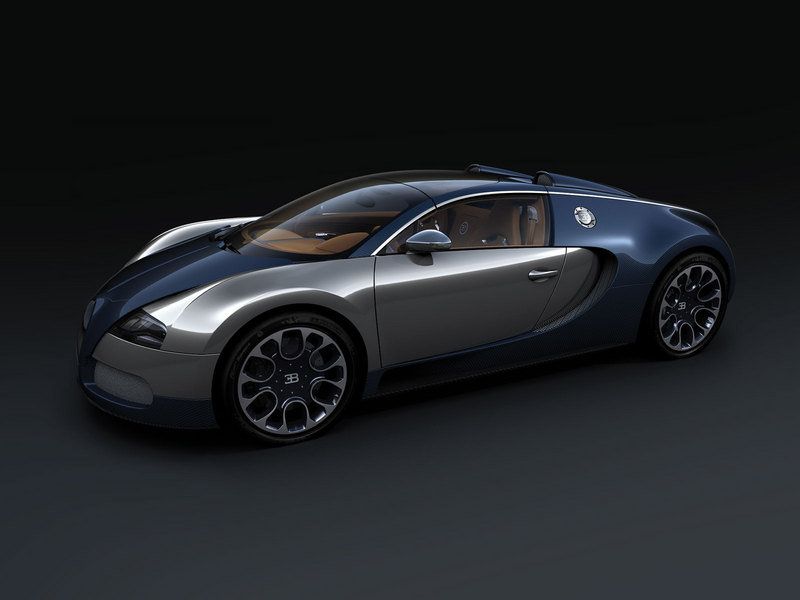
2010 Bugatti Veyron Grand Sport Sang Bleu2010 Bugatti Veyron Grand Sport Sang Bleu

2010 Bugatti Veyron Grand Sport Sang Bleu Picture2010 Bugatti Veyron Grand Sport Sang Bleu Picture