Crossing the Blues
Showing posts with label porsche. Show all posts

Thursday, November 26, 2009

2010 9ff Speed9 Specification

2010 9ff Speed9 Technical Data and Specification

This is 9ff Speed9 bi-turbo engine generations 650 horsepower and delivers 890 nm torque at just 2850 rpm. This is achieved by the 9ff F650 VTG turbochargers, 100 cell sports catalytic converter as well as the 9ff stainless steel exhaust manifolds. Other measures like the 9ff sports air filter, the 9ff ECU upgrade and the 9ff sports exhaust system.

The demanding chassis, consisting of adjustable stabilizers on the front and rear axles, double springs, and four aluminum spring plates, support ambitious driving. One can also count on the 9ff brake system consisting of 380 mm compound brake discs in combination with 6-piston calipers and 9ff brake pads.

The 9ff Speed9 is available as a complete vehicle as well as a rebuilding order on the basis of a Porsche 997 Turbo.2010 9ff Speed9 Specifications


Tuner 9ff

Engine Location Mid

Drive Type Rear Wheel


Engine

Engine Configuration O

Cylinders 6

Aspiration/Induction Twin-turbocharged

Displacement 3.60 L | 219.7 cu in. | 3600.9 cc.

Valves 24 valves.

4 valves per cylinder.

Valvetrain DOHC

Horsepower 650.00 BHP (478.4 KW)

Torque 890.00 NM (656.2 Ft-Lbs)

HP / Liter 180.6 BHP / Liter

Fuel Feed Fuel Injected

Block Aluminum

Head Aluminum


Standard Transmission

Gears 6

Transmission Semi-Automatic

Clutch Twin Clutch

Porsche PDK


2010 9ff Speed9 Specification

2010 9ff Speed9 Technical Data and Specification

This is 9ff Speed9 bi-turbo engine generations 650 horsepower and delivers 890 nm torque at just 2850 rpm. This is achieved by the 9ff F650 VTG turbochargers, 100 cell sports catalytic converter as well as the 9ff stainless steel exhaust manifolds. Other measures like the 9ff sports air filter, the 9ff ECU upgrade and the 9ff sports exhaust system.

The demanding chassis, consisting of adjustable stabilizers on the front and rear axles, double springs, and four aluminum spring plates, support ambitious driving. One can also count on the 9ff brake system consisting of 380 mm compound brake discs in combination with 6-piston calipers and 9ff brake pads.

The 9ff Speed9 is available as a complete vehicle as well as a rebuilding order on the basis of a Porsche 997 Turbo.2010 9ff Speed9 Specifications


Tuner 9ff

Engine Location Mid

Drive Type Rear Wheel


Engine

Engine Configuration O

Cylinders 6

Aspiration/Induction Twin-turbocharged

Displacement 3.60 L | 219.7 cu in. | 3600.9 cc.

Valves 24 valves.

4 valves per cylinder.

Valvetrain DOHC

Horsepower 650.00 BHP (478.4 KW)

Torque 890.00 NM (656.2 Ft-Lbs)

HP / Liter 180.6 BHP / Liter

Fuel Feed Fuel Injected

Block Aluminum

Head Aluminum


Standard Transmission

Gears 6

Transmission Semi-Automatic

Clutch Twin Clutch

Porsche PDK


Monday, November 23, 2009

SpeedART Turbo Porsche Panamera Sports Car Saloon 4.8 liter twin turbo V8 Engine.


German tuner and Porsche specialist SpeedART celibrates its 10th birthday. As a celebration they have created an exhaust package for the Porsche Panamera Turbo.The PS9 package for the German sports saloon ups the ante with numerous aero add-ons and a bevy of performance upgrades. The Sport-Abgas system provides your Panamera with a more raw sound and twenty extra horses.
The Essen Motor Show, which runs from November 28 to December 6 and is best described as Europe’s answer to SEMA, will see Porsche tuning shop, SpeedART, revealing its take on the Panamera.

The kit brings the total output to 520bhp. The sprint of the 4.8 liter twin turbo V8 will probably be hit the 4.0 seconds. Top speed will not increase a lot but 303km/h (190mph) isn’t too bad for a four-door sedan.Set to be officially unveiled at the Essen Motor Show, the range topping PS9 features 650 hp and 890 Nm of torque thanks to bigger turbochargers, a sport exhaust system (with a sound switch), a sport catalyst, and a revised ECU. These changes enable the car to accelerate from 0-62 mph in 3.5 seconds, before hitting a top speed in excess of 200 mph. If 650 hp is too hot to handle, the company also offers more modest performance packages that allow the engine to produce 550 and 600 hp.SpeedART claims that the most powerful version of the car accelerates from zero to 100km/h (62mph) in 3.5 seconds and goes on to achieve a top speed in excess of 320km/h or 200mph.


In terms of styling, the PS9 is outfitted with an aerodynamic body kit which consists of a front chin spoiler, hood vents, a rear diffuser, a roof spoiler, a modified rear bumper (with air outlets), and aggressive side skirts. Other design details include 22-inch three-piece 'LSC FORGED' wheels and the aforementioned sport exhaust system (available in polished stainless steel or matt black).Inside, the cockpit will get a SpeedART steering wheel with F1-shift paddles, real carbon-fiber trim and accents, new leather upholstery with colored stitches and a revised instrument panel.At the back, we see a new bumper, and the trapezoidal exhaust pipes. A new rear spoiler will also be mounted.

For the interior, SpeedART added a sport steering wheel with F1-shift paddles (which can be outfitted with aluminum-, wood- or carbon fiber inlays), carbon fiber trim, contrast stitching on the door panels and seats, revised instrument dials, and exclusive floor mats.

SpeedART Turbo Porsche Panamera Sports Car Saloon 4.8 liter twin turbo V8 Engine.


German tuner and Porsche specialist SpeedART celibrates its 10th birthday. As a celebration they have created an exhaust package for the Porsche Panamera Turbo.The PS9 package for the German sports saloon ups the ante with numerous aero add-ons and a bevy of performance upgrades. The Sport-Abgas system provides your Panamera with a more raw sound and twenty extra horses.
The Essen Motor Show, which runs from November 28 to December 6 and is best described as Europe’s answer to SEMA, will see Porsche tuning shop, SpeedART, revealing its take on the Panamera.

The kit brings the total output to 520bhp. The sprint of the 4.8 liter twin turbo V8 will probably be hit the 4.0 seconds. Top speed will not increase a lot but 303km/h (190mph) isn’t too bad for a four-door sedan.Set to be officially unveiled at the Essen Motor Show, the range topping PS9 features 650 hp and 890 Nm of torque thanks to bigger turbochargers, a sport exhaust system (with a sound switch), a sport catalyst, and a revised ECU. These changes enable the car to accelerate from 0-62 mph in 3.5 seconds, before hitting a top speed in excess of 200 mph. If 650 hp is too hot to handle, the company also offers more modest performance packages that allow the engine to produce 550 and 600 hp.SpeedART claims that the most powerful version of the car accelerates from zero to 100km/h (62mph) in 3.5 seconds and goes on to achieve a top speed in excess of 320km/h or 200mph.


In terms of styling, the PS9 is outfitted with an aerodynamic body kit which consists of a front chin spoiler, hood vents, a rear diffuser, a roof spoiler, a modified rear bumper (with air outlets), and aggressive side skirts. Other design details include 22-inch three-piece 'LSC FORGED' wheels and the aforementioned sport exhaust system (available in polished stainless steel or matt black).Inside, the cockpit will get a SpeedART steering wheel with F1-shift paddles, real carbon-fiber trim and accents, new leather upholstery with colored stitches and a revised instrument panel.At the back, we see a new bumper, and the trapezoidal exhaust pipes. A new rear spoiler will also be mounted.

For the interior, SpeedART added a sport steering wheel with F1-shift paddles (which can be outfitted with aluminum-, wood- or carbon fiber inlays), carbon fiber trim, contrast stitching on the door panels and seats, revised instrument dials, and exclusive floor mats.

Saturday, November 21, 2009

SRS Aerokit SpeedART The Sports Car Porsche Cayman a Sporty and Elegant.

2009 SRS Aerokit SpeedART Porsche Cayman

SRS Aerokit SpeedART The Sports Car Porsche Cayman a Sporty and Elegant.
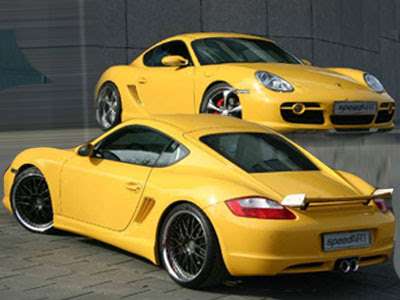
The SRS Aerokit from the German tuning firm SpeedART is a subtle and stylish way to spruce up the Porsche Cayman or Cayman S.
Unlike many bodykits which radically alter the appearance and persona of the car - sometimes for the good, but all to often for the bad - the SRS Aerokit is extremley in tune with the overall shape of the Cayman.The aerodynamic modifications include a 3-piece front chin spoiler - which provides additional downforce over the front axle, new deeper sideskirts, and an adjustable rear spoiler which has a distinct racing look to it. SpeedART have certainly taken the 'less is more' approach to design, and it's paid off.
A newly-enlarged 2.9-litre flat-six engine develops 255 bhp in the Boxster and 265 bhp in the Cayman, an increase of 10 and, respectively, 20 bhp over preceding models. The 3.4-litre power unit in the S versions, benefiting from Direct Fuel Injection, now delivers 310 bhp in the Boxster S and 320 bhp in the Cayman S, up by 15 and 25 bhp.
2009 SRS Aerokit SpeedART Porsche Cayman

The new Boxster and Cayman are significantly more fuel-efficient than their predecessors. The new 2.9-litre Boxer engine sips 8.9 litres of fuel per 100 kilometres (combined) – 11 per cent less than the former models with Tiptronic S. Reducing fuel consumption by 16 per cent to 9.2 litres/100 kilometres, the 3.4-litre versions with PDK offer an even greater saving.
For the first time, both models are available with a Lights Package featuring bi-xenon headlights, dynamic curve lights and LED daytime driving lights. Replacing the foglamps, these light units are made of four LEDs positioned next to one another on the Boxster, while on the Cayman four LEDs are arranged in round light units like the eyes of a dice.
The Boxster and Cayman are available for the first time with the seven-speed Porsche-Doppelkupplungsgetriebe, or PDK, which replaces the former Tiptronic S. Equipped with this double-clutch gearbox, the roadster and coupé accelerate to 100 km/h 0.1 seconds faster than with the six-speed manual fitted as standard on all models.
2009 SRS Aerokit SpeedART Porsche Cayman

PDK cars’ acceleration is even more dynamic with one of the optional Sports Chrono Packages featuring Launch Control for maximum acceleration from a standing start, while the Race Track Gearshift Strategy offers the fastest possible shifting on the track. With Launch Control, the respective models accelerate from a standstill to 100 km/h another 0.2 seconds faster. (For instance, the Cayman S with PDK and Launch Control accelerates to 100 km/h in 4.9 seconds, while the base Boxster with its new six-speed manual gearbox completes the same exercise in 5.9 seconds.)A new suspension set-up gives the new models a combination of even greater driving dynamics and enhanced comfort. Steering forces have been further reduced, giving the Boxster and Cayman even more agile and spontaneous steering behaviour.
2009 SRS Aerokit SpeedART Porsche Cayman

The wheels come in new designs and are half an inch wider on the Boxster and Cayman than in the past in order to accommodate the larger brake system from the S models on the front axle. All Boxster and Cayman models feature the latest generation of Porsche Stability Management (PSM), with two additional functions: Brake Pre-Loading and Brake Assistant.
2009 SRS Aerokit SpeedART Porsche Cayman

Whenever the driver lets go of the gas pedal very quickly – which is typical of an upcoming emergency braking manoeuvre – the PSM control unit builds up an appropriate level of pressure on the brakes before the driver even presses down the brake pedal, moving the brake pads slightly towards the discs, which significantly improves brake response and shortens stopping distances accordingly.


SRS Aerokit SpeedART The Sports Car Porsche Cayman a Sporty and Elegant.

2009 SRS Aerokit SpeedART Porsche Cayman

SRS Aerokit SpeedART The Sports Car Porsche Cayman a Sporty and Elegant.
The SRS Aerokit from the German tuning firm SpeedART is a subtle and stylish way to spruce up the Porsche Cayman or Cayman S.
Unlike many bodykits which radically alter the appearance and persona of the car - sometimes for the good, but all to often for the bad - the SRS Aerokit is extremley in tune with the overall shape of the Cayman.The aerodynamic modifications include a 3-piece front chin spoiler - which provides additional downforce over the front axle, new deeper sideskirts, and an adjustable rear spoiler which has a distinct racing look to it. SpeedART have certainly taken the 'less is more' approach to design, and it's paid off.
A newly-enlarged 2.9-litre flat-six engine develops 255 bhp in the Boxster and 265 bhp in the Cayman, an increase of 10 and, respectively, 20 bhp over preceding models. The 3.4-litre power unit in the S versions, benefiting from Direct Fuel Injection, now delivers 310 bhp in the Boxster S and 320 bhp in the Cayman S, up by 15 and 25 bhp.
2009 SRS Aerokit SpeedART Porsche Cayman

The new Boxster and Cayman are significantly more fuel-efficient than their predecessors. The new 2.9-litre Boxer engine sips 8.9 litres of fuel per 100 kilometres (combined) – 11 per cent less than the former models with Tiptronic S. Reducing fuel consumption by 16 per cent to 9.2 litres/100 kilometres, the 3.4-litre versions with PDK offer an even greater saving.
For the first time, both models are available with a Lights Package featuring bi-xenon headlights, dynamic curve lights and LED daytime driving lights. Replacing the foglamps, these light units are made of four LEDs positioned next to one another on the Boxster, while on the Cayman four LEDs are arranged in round light units like the eyes of a dice.
The Boxster and Cayman are available for the first time with the seven-speed Porsche-Doppelkupplungsgetriebe, or PDK, which replaces the former Tiptronic S. Equipped with this double-clutch gearbox, the roadster and coupé accelerate to 100 km/h 0.1 seconds faster than with the six-speed manual fitted as standard on all models.
2009 SRS Aerokit SpeedART Porsche Cayman

PDK cars’ acceleration is even more dynamic with one of the optional Sports Chrono Packages featuring Launch Control for maximum acceleration from a standing start, while the Race Track Gearshift Strategy offers the fastest possible shifting on the track. With Launch Control, the respective models accelerate from a standstill to 100 km/h another 0.2 seconds faster. (For instance, the Cayman S with PDK and Launch Control accelerates to 100 km/h in 4.9 seconds, while the base Boxster with its new six-speed manual gearbox completes the same exercise in 5.9 seconds.)A new suspension set-up gives the new models a combination of even greater driving dynamics and enhanced comfort. Steering forces have been further reduced, giving the Boxster and Cayman even more agile and spontaneous steering behaviour.
2009 SRS Aerokit SpeedART Porsche Cayman

The wheels come in new designs and are half an inch wider on the Boxster and Cayman than in the past in order to accommodate the larger brake system from the S models on the front axle. All Boxster and Cayman models feature the latest generation of Porsche Stability Management (PSM), with two additional functions: Brake Pre-Loading and Brake Assistant.
2009 SRS Aerokit SpeedART Porsche Cayman

Whenever the driver lets go of the gas pedal very quickly – which is typical of an upcoming emergency braking manoeuvre – the PSM control unit builds up an appropriate level of pressure on the brakes before the driver even presses down the brake pedal, moving the brake pads slightly towards the discs, which significantly improves brake response and shortens stopping distances accordingly.


Friday, November 20, 2009

2010 Porsche 911 GT3 R Pictures

2010 Porsche 911 GT3 R Front View2010 Porsche 911 GT3 R Front View

2010 Porsche 911 GT3 R Sport Car2010 Porsche 911 GT3 R Sport Car

2010 Porsche 911 GT3 R Taillight Rear Wing View2010 Porsche 911 GT3 R Taillight Rear Wing View

Monday, November 16, 2009

2010 Boxster Spyder Porsche Sports Car a 3.4-liter six-cylinder Engine with Direct Fuel Injection

2010 Porsche Boxster Spyder Sports Car

Porsche is introducing a new top version of the Porsche Boxster, a light mid-engined roadster making its world debut at the Los Angeles Motor Show in December. Weighing just 1,275 kg or 2,811 lb, the 2010 Porsche Boxster Spyder is the lightest model throughout the entire range of Porsche cars. Clearly recognisable right from the start, this new mid-engined roadster represents the true, purist form of the Porsche sports car – light, powerful, consistently open, and very efficient.This new mid-engined roadster represents the true, purist form of the sports car – agile, powerful, open and efficient. This third Boxster model will join the Boxster and Boxster S and will make its world debut at the Los Angeles Auto Show, December 2, 2009.
2010 Porsche Boxster Spyder Sports Car

The newest member of the Boxster family stands out from the other versions of Porsche's mid-engined roadster. Its low-slung, lightweight soft top – when closed – extends far to the rear to protect the driver and passenger from bright sunshine, wind and weather. This top, when combined with extra-low side windows and two striking bulges on the single-piece rear lid, provides the Boxster Spyder with a sleek silhouette reminiscent of the Carrera GT.
2010 Porsche Boxster Spyder Sports Car

The Boxster Spyder features a 3.4-liter six-cylinder engine with Direct Fuel Injection upfront of the rear axle. Maximum output is 320 horsepower (hp), 10 hp more than the Boxster S. The Porsche Boxster Spyder accelerates from a standstill to 100 km/h in 4.8 seconds. The Porsche Boxster Spyder top speed, in turn, is 267 km/h or 166 mph – with the roof open.The combination of 10 more hp and 176 pounds less weight than the award-winning Boxster S, plus an all-new sport suspension that lowers the Boxster Spyder 20 mm, a lower center of gravity, a standard limited slip differential, and exclusive wheels provides the kind of driving dynamics that back up the unique look. Aluminum door skins and lightweight interior door panels from the 911 GT3 RS contribute to the weight reduction.
Fundamentally, the entire Boxster family is the successor to the legendary 550 Spyder and RS 60 of the Fifties and Sixties, all sharing the same mid-engine roadster concept. Low weight and supreme agility combine to provide outstanding driving pleasure.
2010 Porsche Boxster Spyder Sports Car

Market introduction of the new Porsche Boxster Spyder will start worldwide in February 2010. The base price in the Euro countries is 53,100 Euro. Including 19 per cent VAT and national specifications, the market price of the new Porsche Boxster Spyder is 63,404 Euro.Boxster Spyder is a regular, but specially developed and upgraded production model as compared with the Boxster and Boxster S.

2010 Boxster Spyder Porsche Sports Car a 3.4-liter six-cylinder Engine with Direct Fuel Injection

2010 Porsche Boxster Spyder Sports Car

Porsche is introducing a new top version of the Porsche Boxster, a light mid-engined roadster making its world debut at the Los Angeles Motor Show in December. Weighing just 1,275 kg or 2,811 lb, the 2010 Porsche Boxster Spyder is the lightest model throughout the entire range of Porsche cars. Clearly recognisable right from the start, this new mid-engined roadster represents the true, purist form of the Porsche sports car – light, powerful, consistently open, and very efficient.This new mid-engined roadster represents the true, purist form of the sports car – agile, powerful, open and efficient. This third Boxster model will join the Boxster and Boxster S and will make its world debut at the Los Angeles Auto Show, December 2, 2009.
2010 Porsche Boxster Spyder Sports Car

The newest member of the Boxster family stands out from the other versions of Porsche's mid-engined roadster. Its low-slung, lightweight soft top – when closed – extends far to the rear to protect the driver and passenger from bright sunshine, wind and weather. This top, when combined with extra-low side windows and two striking bulges on the single-piece rear lid, provides the Boxster Spyder with a sleek silhouette reminiscent of the Carrera GT.
2010 Porsche Boxster Spyder Sports Car

The Boxster Spyder features a 3.4-liter six-cylinder engine with Direct Fuel Injection upfront of the rear axle. Maximum output is 320 horsepower (hp), 10 hp more than the Boxster S. The Porsche Boxster Spyder accelerates from a standstill to 100 km/h in 4.8 seconds. The Porsche Boxster Spyder top speed, in turn, is 267 km/h or 166 mph – with the roof open.The combination of 10 more hp and 176 pounds less weight than the award-winning Boxster S, plus an all-new sport suspension that lowers the Boxster Spyder 20 mm, a lower center of gravity, a standard limited slip differential, and exclusive wheels provides the kind of driving dynamics that back up the unique look. Aluminum door skins and lightweight interior door panels from the 911 GT3 RS contribute to the weight reduction.
Fundamentally, the entire Boxster family is the successor to the legendary 550 Spyder and RS 60 of the Fifties and Sixties, all sharing the same mid-engine roadster concept. Low weight and supreme agility combine to provide outstanding driving pleasure.
2010 Porsche Boxster Spyder Sports Car

Market introduction of the new Porsche Boxster Spyder will start worldwide in February 2010. The base price in the Euro countries is 53,100 Euro. Including 19 per cent VAT and national specifications, the market price of the new Porsche Boxster Spyder is 63,404 Euro.Boxster Spyder is a regular, but specially developed and upgraded production model as compared with the Boxster and Boxster S.

Saturday, November 7, 2009

2010 Porsche Boxster Spyder

2010 Porsche Boxster Spyder Front Angle View2010 Porsche Boxster Spyder Front Angle View

2010 Porsche Boxster Spyder Car Wallpaper2010 Porsche Boxster Spyder Car Wallpaper

2010 Porsche Boxster Spyder Interior2010 Porsche Boxster Spyder Interior

2010 Porsche Boxster Spyder Side View2010 Porsche Boxster Spyder Side View

2010 Porsche Boxster Spyder Sport Car2010 Porsche Boxster Spyder Sport Car

2010 Porsche Boxster Spyder Rear Angle View2010 Porsche Boxster Spyder Rear Angle View

Friday, October 16, 2009

2010 Mansory Porsche Panamera

2010 Mansory Porsche Panamera Top Picture2010 Mansory Porsche Panamera Top Picture

2010 Mansory Porsche Panamera Side View2010 Mansory Porsche Panamera Side View

2010 Mansory Porsche Panamera Top View2010 Mansory Porsche Panamera Top View

2010 Mansory Porsche Panamera Car Wallpaper2010 Mansory Porsche Panamera Car Wallpaper

2010 Mansory Porsche Panamera Rear View2010 Mansory Porsche Panamera Rear View

Thursday, October 8, 2009

The 9FF GT9 Porsche Sport Car


Porsche Sport Car 9FF GT9

Porsche Sport Car 9FF GT9 the engine features titanium con-rods and forged pistons, which was necessary to handle the 987hp output. Peak torque of 964Nm falls between 5,970 and 7,850rpm.
The 911 GT3 body, on which it’s based, has also been stretched by 300mm and has had the roof lowered by 120mm to maximize downforce at high speeds. Thanks to carbon-fiber and Kevlar construction, the entire vehicle will weigh in at just 1,326kg.
Although the car is loosely based on a Porsche 911, its mechanical package has been totally revised. Ditching the 911’s rear-engine layout, 9ff engineers created a custom mid-mounted engine design utilizing the tuner’s twin-turbo 4.2L flat-six engine.
Stranded somewhere between a racing car and everyday transport,the interior of the GT9 is, it has to be said, eye cancer material. Fatthauer's genial wife decided on the race suit-style dash and door trimmings and it makes you wonder what their house is like. Luckily it's a bespoke car, so the owners will get their choice of interior and it's hard to imagine anyone demanding this one. Still, it comes with a real stereo, passenger airbag and more, transplanted deftly from the interior of a 911, and Porsche owners will recognise most of the components on display - from the ignition slot right through to the handbrake and indicator stalks.

The 9FF GT9 Porsche Sport Car


Porsche Sport Car 9FF GT9

Porsche Sport Car 9FF GT9 the engine features titanium con-rods and forged pistons, which was necessary to handle the 987hp output. Peak torque of 964Nm falls between 5,970 and 7,850rpm.
The 911 GT3 body, on which it’s based, has also been stretched by 300mm and has had the roof lowered by 120mm to maximize downforce at high speeds. Thanks to carbon-fiber and Kevlar construction, the entire vehicle will weigh in at just 1,326kg.
Although the car is loosely based on a Porsche 911, its mechanical package has been totally revised. Ditching the 911’s rear-engine layout, 9ff engineers created a custom mid-mounted engine design utilizing the tuner’s twin-turbo 4.2L flat-six engine.
Stranded somewhere between a racing car and everyday transport,the interior of the GT9 is, it has to be said, eye cancer material. Fatthauer's genial wife decided on the race suit-style dash and door trimmings and it makes you wonder what their house is like. Luckily it's a bespoke car, so the owners will get their choice of interior and it's hard to imagine anyone demanding this one. Still, it comes with a real stereo, passenger airbag and more, transplanted deftly from the interior of a 911, and Porsche owners will recognise most of the components on display - from the ignition slot right through to the handbrake and indicator stalks.